
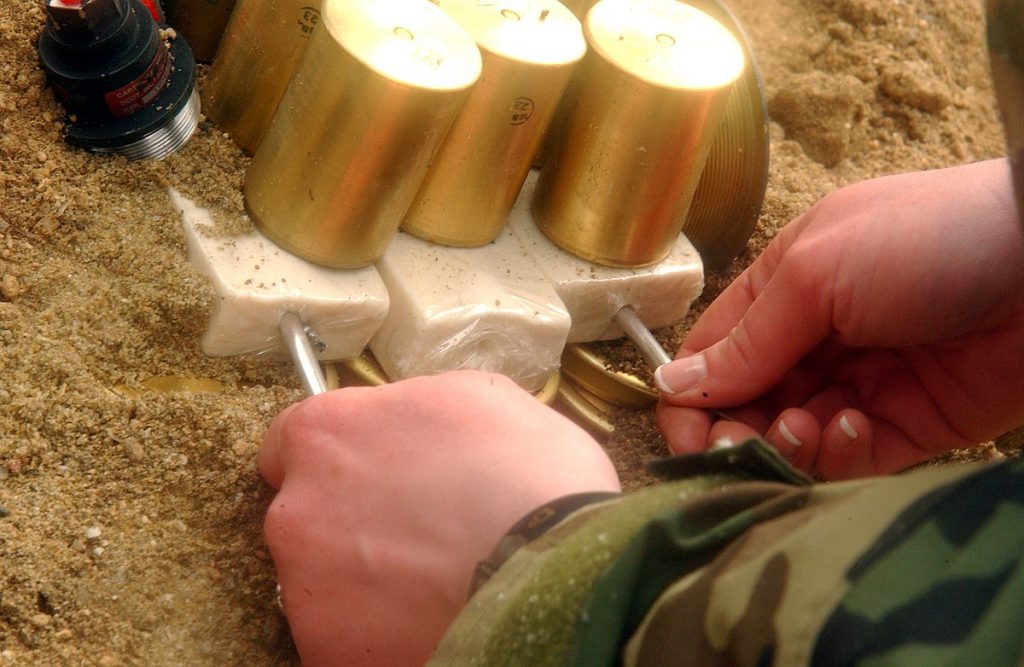

C4 is a type of plastic explosive common in the United States. In the Ukrainian language, the name is usually used in the forms ci-four and ci-for.
The C-4 explosive mixture has a light brown color and the consistency of soft clay. It retains plasticity in the temperature range from -57 °C to +77 °C. Due to its good properties, C-4 almost completely replaced the other C mixtures. In its pure form, it is odorless and non-toxic, as it does not contain aryl nitro compounds. However, when burned, it emits toxic fumes.
C-4 consists of:
Hexogen – about 91% by weight
polymeric binder – polyisobutylene (butyl rubber) – 2.1%,
plasticizer – di-(2-ethylhexyl)-sebacinate or dioctylsebacinate – 5.3%,
engine oil of SAE 10 specification – 1.6%.
C4 is produced by mixing hexene with a solution of the other components in a suitable solvent. The solvent is then evaporated and the mixture is dried.
Since the mixture obtained in this way is odorless, a chemical label (for example, 2,3-dimethyl-2,3-dinitrobutane) is added to its composition to determine the type of explosive and its origin.
C4 is widely known for its plasticity. It can fill gaps in buildings and structures and take on any desired shape. In addition, C4 is known for its reliability and stability. The sensitivity to impact is 48 cm (TNT 90-100 cm) for a 2 kg payload. A reliable way to cause an explosion is to use an electric detonator or a detonator capsule.
The mixture’s splashability is 116 % trinitrotoluene. It can be manually crushed to a density of 1.58-1.60 g/c³. The detonation velocity is 8050 m/s at room temperature.
Leave a Comment
You must be logged in to post a comment.